

.webp?language=en-US)

.webp?language=en-US)
Unprecedented Coalition of Cultural Heritage and Architecture Groups Sue To Require Federal Review of President Trump’s Kennedy Center Plans
Three Law Firms Unite to Advance Plaintiffs’ Claims
Washington, DC – March 23, 2026 – A coalition of eight leading cultural heritage and architectural organizations jointly represented by three law firms today filed suit in federal district court in Washington, DC seeking to require the Trump administration to comply with historic preservation laws and secure Congressional authorization before implementing the President’s plans to further alter the John F. Kennedy Center for the Performing Arts.
The filing follows statements by President Trump that he may take the building “down to the steel” during a two-year closure beginning July 4, 2026. Plaintiffs cite the lesson learned when the President assured the American public that the East Wing of the White House would remain untouched during construction of his ballroom—and then approved its complete demolition.
The plaintiffs include: the American Institute of Architects; the American Society of Landscape Architects; the Committee of 100 on the Federal City; the DC Preservation League; Docomomo US; the National Trust for Historic Preservation; the Society of Architectural Historians; and The Cultural Landscape Foundation. Collectively, the organizations have more than one million members and supporters.
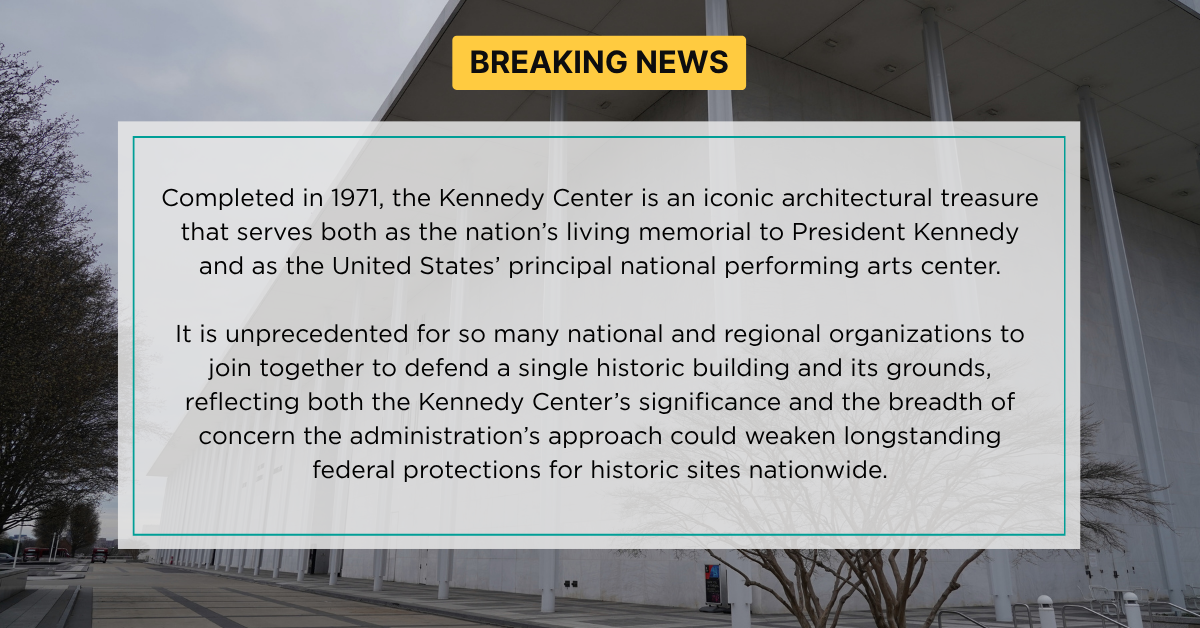
Completed in 1971, the Kennedy Center is among the most prominent cultural institutions in the United States and an iconic architectural treasure. The building and grounds have been determined eligible for listing on the National Register of Historic Places, which triggers processes and protections under the National Historic Preservation Act (NHPA) and the National Environmental Policy Act (NEPA).
Because the Kennedy Center serves both as the nation’s living memorial to President Kennedy and as the United States’ principal national performing arts center, changes to the building and grounds carry cultural and symbolic significance far beyond the nation’s capital.
The lawsuit, and a request for a preliminary injunction that plaintiffs expect to file soon, will ask the court to halt any demolition or substantial alteration until the government completes required public review and consultation processes.
The complaint makes clear that plaintiffs do not challenge routine repairs and maintenance, for which Congress recently appropriated $257 million. Rather, plaintiffs seek to prevent irreversible harm to defining architectural and historic features without the process and authority required by law.
No plaintiff can remember an instance in which so many national and regional organizations have coalesced to defend a single historic building and its grounds, reflecting both the Kennedy Center’s significance and the breadth of concern that the administration’s approach could weaken longstanding federal protections for historic sites nationwide.
The case also brings together for the first time three law firms whose clients have challenged several other high-profile efforts by the administration to alter historic federal properties without following legally required review processes.
In November, Cultural Heritage Partners filed suit to prevent the administration from painting the historic granite façade of the Eisenhower Executive Office Building without public consultation. In December, Foley Hoag challenged plans to construct a large ballroom following demolition of the White House East Wing. In February, Lowell & Associates sued seeking to enjoin the planned redevelopment of the historic East Potomac Golf Course and the dumping of East Wing demolition debris on the site.
Quotes
Rebecca Miller, Executive Director, DC Preservation League:
“The Kennedy Center is not a personal project of any president. It is a national cultural monument built to honor John F. Kennedy and to serve the American people. Federal law requires transparency, expert review, and public participation before it can be fundamentally altered.”
Carol Quillen, President and CEO, National Trust for Historic Preservation:
“The Kennedy Center is a historically significant architectural icon and a performance venue beloved by millions of Americans. We’re concerned that, as with the White House East Wing, the potential scope of planned changes is understated and will result in irreparable loss. We respectfully urge the Administration to follow all required consultative processes. Doing so will improve the design and enable transparency and public engagement—values befitting a government by the people.”
Greg Werkheiser, Founding Partner, Cultural Heritage Partners:
“The administration is advancing sweeping changes to some of the nation’s most important civic landmarks without transparency or public process. When decisions about America’s heritage are made behind closed doors, the rule of law is the only safeguard.”
Abbe David Lowell, Founding Member, Lowell & Associates:
"This case is not about politics or aesthetics. It is about whether the President can impose major changes to historic buildings while denying the public voice that federal law requires.”
Tad Heuer, Partner, and Greg Craig, Senior Counsel, Foley Hoag:
“We are proud to represent this coalition of cultural heritage and architectural organizations to ensure that the processes in place are followed before irreparable changes are made to an iconic building intended to be a lasting and living memorial to John F. Kennedy.”
Illya Azaroff, President, American Institute of Architects:
“Architects have a responsibility to protect the integrity of our nation’s civic and cultural landmarks. The Kennedy Center is a public asset that must be shaped through transparency, expertise, and the communities it serves.”
Charles A. Birnbaum, Founding President & CEO, The Cultural Landscape Foundation:
“The Kennedy Center campus is a nationally significant example of Modernist design. From its processional arrival experience to its terraces, which afford sweeping views of the Potomac River and civic monuments, landscape architecture is integral to this important cultural monument.”
Liz Waytkus, Executive Director, Docomomo US
“It is unconscionable that the administration has already begun actions to degrade and irreparably harm the Kennedy Center. Designed by Edward Durell Stone, the building is a masterwork of Modern architecture and one of the most significant Modern buildings in the Washington, D.C., area. Significant alterations to the Kennedy Center would not only compromise an architectural landmark but would undermine a place deeply tied to the nation’s cultural values and to the legacy of leadership that President Kennedy represented.”
Ben Thomas, Executive Director, Society of Architectural Historians:
“SAH, a network of institutions and individuals that focus on the history of the built environment and its impact on society, joins the other seven plaintiffs to urge the administration to submit any proposals to alter the Kennedy Center for proper review and deliberation. Decisions that affect our communal cultural heritage should not be made lightly and should follow established guidelines and procedures.”
Brad McCauley, President, American Society of Landscape Architects:
“The Kennedy Center and its grounds are part of our shared public realm. Federal law requires careful, informed reviews to guide decisions about its future, accounting for preservation law, public input, cultural understanding, and long-term stewardship. Following proper process to honor the Kennedy Center’s role as a national civic landmark matters.”
Judy Chesser, Chair, Committee of 100 for the Federal City:
“The Kennedy Center is a national treasure. Its construction set new standards, from accessibility to acoustics. Without public input and congressional approval as required by law, the Administration’s statements that its intentions are only to ‘enhance’ the Center are not reassuring but are cause for alarm.”
About the Plaintiffs
- The American Institute of Architects (AIA): With 101,000 members, AIA is the world’s largest, most influential network of architects and design professionals. Founded in 1857, AIA consistently works to create more valuable, healthy, secure, and sustainable buildings, neighborhoods, and communities. Through more than 200 international, state and local chapters, AIA advocates for public policies that promote economic vitality and public wellbeing.
- American Society of Landscape Architects: Founded in 1899, the American Society of Landscape Architects (ASLA) is the professional association for landscape architects in the United States, proudly representing more than 16,000 members. Landscape architects lead the planning, design, and stewardship of healthy, equitable, safe, and resilient environments.
- Committee of 100 on the Federal City: Founded more than a century ago, the Committee of 100 on the Federal City is a nonprofit organization dedicated to safeguarding and advancing Washington’s historic distinction, natural beauty, and overall livability. The Committee’s work recognizes the critical value of public planning, informed by traditions that originate from the L’Enfant Plan and the McMillan Commission, continuing to the current day.
- DC Preservation League: Founded in 1971, the DC Preservation League (DCPL) has played a major role in advocating for the preservation, protection, and enhancement of significant landmarks, neighborhoods, and cultural sites across all eight wards of Washington, D.C. The membership supported nonprofit carries out its work through advocacy, public education, and partnerships with government agencies and community groups.
- Docomomo US is the United States chapter of Docomomo International, a non-profit organization dedicated to the documentation and conservation of buildings, sites and neighborhoods of the modern movement. Committed to the principle that modern design merits the attention and preservation received by earlier periods, Docomomo US represents twenty-eight regional chapters and partner organizations that share knowledge of and enthusiasm for modern architecture, landscapes, and design.
- National Trust for Historic Preservation is a privately-funded nonprofit organization dedicated to helping communities maintain and enhance the power of historic places. Chartered by Congress in 1949 and supported by partners, friends, and champions nationwide, the Trust helps preserve the places and stories that make communities unique. Through the stewardship and revitalization of historic sites, the Trust helps communities foster economic growth, create healthier environments, and build a stronger, shared sense of civic duty and belonging.
- Society of Architectural Historians: Founded at Harvard University in 1940, SAH is a nonprofit membership organization that serves an international network of institutions and individuals who, by profession or interest, focus on the history of the built environment and its role in shaping contemporary life. SAH promotes the study, interpretation, and conservation of architecture, design, landscapes, and urbanism worldwide for the benefit of all.
- The Cultural Landscape Foundation (TCLF) is a 501(c)(3) non-profit founded in 1998 to connect people to places. TCLF educates and engages the public to make our shared landscape heritage more visible, identify its value, and empower its stewards. Through its website, publishing, lectures, and other events, TCLF broadens support and understanding for cultural landscapes. TCLF is also home to the Cornelia Hahn Oberlander International Landscape Architecture Prize.
About the Law Firms
- Cultural Heritage Partners, PLLC (CHP) uses law, policy, and public attention to protect and preserve archaeology, art, architecture, landscapes, burial grounds, sacred spaces, traditional knowledge and practices, and related civil and human rights. The firm's clients include Indigenous nations, African American communities, historic cities and towns, and cultural institutions globally. Since its founding in 2010, the firm has been led by Marion F. Werkheiser and Greg Werkheiser.
- Foley Hoag, is an award-winning, mid-sized, international law firm that focuses on innovative industries and high-stakes litigation. The firm maintains robust offices in Boston, New York, Washington, DC, Denver, and Paris. The diverse backgrounds, perspectives, and experiences of the firm’s lawyers and business services professionals contribute to the exceptional service Foley Hoag delivers to clients. Counsel in this matter are Greg Craig, Tad Heuer, and Matt Casassa.
- Lowell & Associates, PLLC provides strategic, principled legal representation across civil, criminal, compliance, congressional, and regulatory matters. Led by its Founding Member, Abbe David Lowell, the firm’s mission is the provision of pro bono and public interest representation in matters that defend the integrity of the legal system and protect individuals and institutions from government overreach and other threats to fundamental rights.
Track all developments on this case at https://www.culturalheritagepartners.com/kennedy-center/.
Contact:
Greg Werkheiser, Founding Partner
Cultural Heritage Partners, PLLC
1717 Pennsylvania Avenue NW, Suite 1025, Washington, DC 20006
(703) 408-2002 / [email protected]
# # #